Saturday, July 28, 2018

High school football’s siren call


Texas high school football season is upon us. And for reasons I can’t adequately explain, I’ll once more write weekly game stories about the fortunes of the 2018 Southlake Carroll Dragons.

Practice begins in two weeks, and the Dragons scrimmage Arlington High on Aug. 25. They open the season against South Grand Prairie in Warrior-Gopher Stadium on Aug. 30.

So the end of summer is nigh, and it’s time to shake off the cobwebs and to check in on Carroll's latest gridiron stalwarts and their new coach, Riley Dodge. What will Dodge Ball 2.0 bring us all?

To be honest, I had some reservations about continuing my game accounts. After all, I’ve never made any effort to gather an audience for Dragon Tales, and my readership is so small that I could probably accomplish the same result with a couple of phone calls.

And although I enjoy the games and like the challenge of capturing their flavor and content, the writing and analysis does take a sizeable chunk out of my weekends.

Ultimately, I decided to give it another go. I’m fascinated at the prospects of the legendary Todd Dodge’s son taking over the team and the resulting excitement it has generated throughout Dragon Nation. But I’m motivated by something else that I have always had trouble explaining to my friends and family.

I’ve been following Dragon football ever since my daughter started high school. I had attended a few Southlake playoff games over the years, but I didn’t become a Dragon fanatic until Rachel started playing clarinet in the Dragon Marching Band.

That was back in 2006, and the Dragons were at the tail end of their legendary Run, when they traveled to five straight state championship games and came within a single point of winning them all. As it was, they had to settle for only four out of five, a record that perhaps will never be repeated.

Marice and I followed Rachel and the Dragons that entire season, missing only a frigid, wind-swept playoff game against Odessa Permian in Texas Tech’s Jones Stadium. Southlake won that one, and every game that season, including the championship game against Austin Westlake in San Antonio’s Alamodome.

It wouldn’t win another state football title for five long years, but I was hooked on the Dragons. I’ve missed only a handful of games since then, but I’ve had my butt in my pricey season green seat for every single home game.

I know. It’s a sickness.

My passion for high school football in general and Carroll Dragon football in particular didn’t come naturally. My friends who are aware of my obsession are surprised to learn I never played the game. To my lingering shame and dismay, my mother deemed the sport too dangerous and forbid me from playing.

I meekly submitted to her wishes, an act of cowardice I wish I could take back. I seriously think my reluctance to challenge her decision is the reason I’m such a contrarian today, suspicious and wary of authority in any form. I resist as much out of reflex as I do conviction. I’m still trying to prove to myself that I’m not a milquetoast who shrinks from conflict and kowtows to brute force.

When it came time for my son to play sports, he seized on football early. He loved flag football, and when he got old enough, he told me he wanted to put on pads and play tackle.

“I’m ready to hit somebody,” he said, secretly delighting me.

And he played with joy and ferocity, suffering his share of nicks and bruises and more serious injuries, including a broken wrist and, alarmingly, a concussion in his first 8th grade game.

He played another year after he recovered from that injury, but at the end of his freshman year he told me he wanted to hang up his cleats.

“You told me,” he said solemnly, “that I was playing for me, not for you, and that when I wanted to quit, I could. It’s time.”

As I looked at him with a complicated mix of pride and regret, I felt the hot sting of tears.

Sadly, I reflected that I would never labor on game nights with the other football dads to erect the huge, inflatable football helmet that Dragon players run through before opening kickoffs, a desire I had harbored in secret since the first Carroll game I ever attended.

Instead, I would have to be content to be a Dragon fan, to sit in the stands and cheer on other dads’ sons as they participated in the grand, colorful, exhilarating tradition of Friday Night Lights.

So if I’m completely honest, I guess my affection for high school football is in some measure a pathetic attempt to recapture an experience I missed both as a youngster and as a father. That makes me a sad-freaking-sack, doesn’t it?

Of course, there’s more to it than that. I love the pageantry and hoopla of the whole affair – the marching bands, the drill squads, the pyramids of cheerleaders, the parade of flags carried across the field after every score.

And I love the purity of high school athletics. In this era of scandal-plagued college programs and the ego- and money-driven excesses of pro football, high school programs have largely escaped unscathed, at least so far.

It’s true that there are haves and have-nots in high school programs. Full disclosure, Southlake Carroll is definitely in the have category. Its well-heeled parents guarantee it. But money hasn’t corrupted the system at the high school level in the way it has in college and the pros.

A few of the best players on the field will go on to play college football at some level. But most will not. They are not playing for college scholarships or for the dream of an NFL contract. They play because they love the game, the comradeship, the teamwork, the satisfying rush of being involved in a desperate struggle with your brothers in arms. School spirit, a laughable concept anywhere else, has real meaning on the turf of a high school football stadium.

If you doubt it, just sit down and talk to a high school athlete. Have a real conversation and ask him or her what motivates them, what sends the football kids to the practice field in the second week of the hottest month in Texas? Why do they devoutly hope – as Dragon players do – that they’ll be compelled to leave their families’ holiday celebrations to attend Thanksgiving Day practices? Because that means they and their comrades are still in playoffs and still in the hunt for a state title.

These are great kids, the last best hope for this sad, battered country of ours. And I feel honored to tell their stories and record both their triumphs and their heartbreaks, even if it is for no pay in service to an audience so tiny it could fit in a good-sized phone booth.

You may see some changes in format this year. They’re intended to increase readability and to encourage brevity over tiresome bloviation, which I have elevated of late into a fine art.

Do you hear that? It’s high school football’s siren call. Go Dragons!

Friday, July 20, 2018

On a summer night in 1969


It’s been 49 years since man first landed on the Moon, and I remember that summer night with a clarity that both surprises and delights me.

I had been a science fiction fan ever since I graduated from Dick and Jane books to more substantive fare. I had traveled to many worlds, countless galaxies and across the universe and back in the company of adventurers, scientists, intergalactic space cops and extraterrestrials of every color, shape and size, aliens good and aliens very, very bad.

Going to the moon? Pish posh. Old hat.

Except, of course, that this was for real, and not some wild tale in Astounding Science Fiction or Amazing Stories, or one of Robert A. Heinlein’s brilliantly imagined novels like Have Spacesuit, Will Travel or Starship Troopers, Glory Road or The Moon is a Harsh Mistress.

Nope. This was really happening. Apollo 11 had landed on the surface of the Moon earlier in the day, and now Buzz Aldrin and Neil Armstrong were preparing to leave their lunar module (why not just call it a spaceship, dammit) and take a walk around – an event that would change history forever.

My friend Scott Medford and I had been outside most of the evening, too excited to sit in front of my parents' black-and-white console TV and watch news coverage.

Scott lived across the street, and we had been buds since elementary school. He was one year younger than me, but that had mattered little for most of our lives. Things were about to change, however.

I had graduated from high school two months before, and Scott had a year to go. The one-year difference in age was about to widen into a gulf. College men (ahem) did not chum around with high school kids. I didn’t make the rules, I just lived by them. We both were beginning to realize that in many ways, this would be our last summer together, and this night – when man first stepped on the surface of the Moon – would be our last great adventure.

July 20, 1969, was a typical summer night in West Texas. Hot, zero humidity, not a breath of wind. As we lay on the driveway across the street from my house on Big Spring’s Morrison Drive, the wide open sky spread before us and not a single cloud blocked the wide expanse of stars. Strangely, I don’t remember whether the moon was up or not. I should remember that, given the extraordinary circumstances of the day. But I don’t.

I do remember the stars, bright and razor-sharp. If you stared at them long enough, they seemed to envelop you, sweeping you up off the hot, sun-warmed cement and propelling you out into the vastness of space, stars and more stars above you, below you and on either side.

And yet, instead of gasping for breath in the vacuum of space, you were breathing easily, slow, deep breaths, the smell of the newly cut lawn down the street strong in your nostrils.

 Breathing in and out, in and out, in … and then jerking upright at the sound of my mother calling from the front door. “Kerry, Scott, they’re about to open the hatch,” she said, her voice tight with excitement.

We hurried inside and joined her and my father in front the TV to listen to an emotional Walter Cronkite describe the scene with growing delight and satisfaction.

None of us said a word. We sat huddled around the set and watched in complete silence, overwhelmed by the immensity of the occasion and lost in our own thoughts about what it all meant.

I remember feeling a little disappointed and then feeling guilty at being disappointed.

NASA, then as now, was run by engineers who had studiously scrubbed the romance and drama out of every vestige of the space program. For instance, that silly business of calling the astronauts' spacecraft a lunar module. Module? Holy Christ, save us from engineers!

To my teenage mind, NASA needed more Star Trek and less techno mumbo-jumbo. Thank God for Cronkite, who was as gleeful as a little kid and didn’t bother to hide it in stiff-upper-lip jabber like the NASA spokesmen did.

We watched Armstrong descend the ladder and step off into the lunar dust, uttering those famous words. For hours, we gazed in wonder as Armstrong and Aldrin went about their proscribed chores. Then Scott left for home and my parents went to bed. I stayed up until the moonwalkers were safely back in their spaceship, then turned off the TV and went back outside.

I lay down in the grass of our front lawn and looked unseeingly at the starry canopy above me. In eight days, I would turn 18, and I started college in a month. My body was abuzz with anticipation. About what, I did not know.

Monday, June 4, 2018

The transformative power of storytelling


Storytelling is a noble art, and I guess I should think so. In one way or another, I’ve been chasing stories my entire working life in a never-ending effort to discover the most effective way to tell them.

At UNT Health Science Center, where I ended up after almost 40 years in the newspaper business, the president calls my team his “storytellers.” I can’t think of a higher compliment he could have paid us.

Even before I made a living by finding and telling stories, I sought them diligently as a kid, tracking many of them down at the Howard County Library in Big Spring. I devoured the entire Hardy Boys series – following Joe and Frank and their buddy Chet as they hopped in their jalopy and pursued criminals all over the countryside.

Then I moved to the science fiction section – soaring to the stars and traveling back in time to roam with the dinosaurs – and on to countless other books that carried me away from the dull, dusty streets of West Texas and took me around the world and beyond.

I was particularly entranced by the tales of Robert E. Howard, an author of fantasy stories set in a mythical time and place. If the name isn’t familiar, his most famous character probably is – Conan the Barbarian.

Howard lived most of his life in Cross Plains, Texas, only a few miles from where I was born. He, too, was intoxicated by stories – stories of his own making that took him out of Cross Plains, a tiny dot on the map peopled by peanut farmers and tradesmen, and took him to the ancient land of Cimmeria. There, Conan, a fearless warrior stout of heart and handy with a blade, fought wizards, defeated armies single-handedly and rescued half-clad slave girls.

What Howard’s racy novels were doing on the staid and sanitized bookshelves of Howard County Library, I’ll never know. But I found them and spent a delightful summer with my head buried in their gory, mystical and sexy pages.

As I grew older, my taste in literature matured. By 13, my two favorite authors were Ernest Hemingway and Leon Uris, the latter a best-selling author in the 1950s, '60s and '70s of such novels as Exodus, Armageddon and Battle Cry. I decided I wanted to be a writer like them, to tell stories like they did, stories that would mesmerize readers like their stories did me.

When I discovered both had worked for newspapers before becoming authors, that settled things. I would be a newspaper man, learn the writing trade like my heroes and eventually become a novelist.

As a young reporter, I ran across a book that had a profound impact on my life and my world view.  During a frenzied 72-hour reading marathon, I consumed Robert Penn Warren’s All the King’s Men, an exquisitely told tale about the corrosive lure of power, the inescapable burden of guilt and the soothing balm of love.

Great literature can change the course of our lives, and great stories can teach us lessons we carry with us forever. So it was with Warren’s magnificent opus and me. It taught me the world is a messy, complicated place, and I began to question my childish notion that it divided neatly into clear-cut issues of black and white. After reading of Jack Burden's final decision to "go into the convulsion of the world," I would never look at life the same way again. The boy had become the man.

Some years ago, I received additional insight into the power of storytelling. During one of my trips to Mexico City as the Dallas Morning News’ international editor, I came across a photograph in a weekend street market not far from the DMN bureau there.

It shows a Mexican farmer leaning on the wall of his home, his saddled horse standing ready beside him. In the mid-distance, a wisp of smoke rises from a mountaintop.

It’s a striking photo, very atmospheric, full of shadow and mystery. The farmer stares pensively ahead, his arms crossed, his mood impenetrable.

In some ways, it’s a stereotypical image of Mexico, from the battered sombrero on the farmer’s head to the long serape in which he’s wrapped. But it also demands explanation and illumination. I stood looking at it for a long while before moving to the next artisan’s stall.

But I couldn’t get the photograph out of my head. I turned back and studied it for minutes more. The photographer, a distinguished man in his 70s, white hair swept back from his forehead, watched without comment as I peered intently at the photo and, again, moved on.

On my third pass, he rose from his chair and approached me.

“I think perhaps I should tell you a story,” he said in perfect English.

“He is waiting for his wife. Soon they will leave their home for safety. Because you see, the smoking mountain is a volcano that erupted back in the 1940s in a cornfield in Michoacan. In less than a week, the man’s home and fields will be covered in lava forever.”

The photographer had read me correctly. I was captivated and enthralled by the image, but it took the story attached to it to close the deal. The photograph now hangs in a front room of my home, above the stuffed leather chair where I do most of my reading.

Stories, you see, are important. They are vital. They bring meaning and offer context to the world. Oregon author Brian Doyle said they “are ways to jazz your life – and maybe that shoves us a little closer toward light.”

In my current job, we look for stories that illustrate the important work we do at the Health Science Center and for stories that demonstrate how deeply invested we are in the Fort Worth community.

It’s true that we concentrate on stories that celebrate our successes rather than dwell on our failures. But we’re governed by the conviction that we craft a stronger, more compelling message if we employ the allure of good story-telling, rather than a rah-rah, strongly promotional approach.

At a recent conference I attended in Seattle, where editors of university publications from across the country gathered, one of the main messages was about the effectiveness of story-telling. The emphasis was on finding good stories and telling them in the most effective way. Marketing and promotion rarely came up.

During the meeting, tributes were offered up to Doyle, longtime editor of the University of Portland’s Portland Magazine. A regular at the annual gatherings, he died last year of cancer.

 “I am a storycatcher,” he once said, “charged with finding stories that matter, stories about who we are at our best, who we might still be, because without stories we’re only mammals with weapons.”

Tuesday, May 15, 2018

Tom Wolfe, truly the right stuff


Tom Wolfe, as faithful and astute an observer of the American experience as any writer I know, is gone. He died Monday at the grand age of 88. Thankfully, his works live on.

They will continue to be read because they offer a wise, insightful and entertaining look into the age in which Wolfe lived. Together, his nonfiction and his fiction comprise a brilliantly written and reported history of our times – our victories, our defeats, our joys, our tragedies, both our nobilities and our absurdities.

The Right Stuff is one of his best books, and my favorite. It’s many things at once: a rumination on what makes a hero, a keen observation of the earliest days of the space program and a series of riveting character studies. Its vibrant prose, attention to detail and spot-on dialogue make it almost impossible to put down.

The first Wolfe book I ever read was The Electric Kool-Aid Acid Test, his account of a cross-country, acid-fueled trip with Ken Kesey and his Merry Pranksters. It is, hands down, the best depiction of the ’60s counterculture you’ll find.

Two collections of essays are worth noting: The Kandy-Kolored Tangerine-Flake Streamline Baby and Radical Chic and Mau-Mauing the Flak Catchers. He also wrote critically acclaimed fiction, most notably Bonfire of the Vanities and A Man in Full.

I had to discover Wolfe on my own. As a journalism student in the late 1960s and early 1970s, I was taught to hate him and the damage he and his other co-conspirators were doing to traditional journalism with their hoity-toity, new-fangled, partly truth and partly fiction “New Journalism.”

New Journalism, the evil creation of a cabal of New York writers weary of the uninspiring conventions of American journalism, would lead to the ruin of us all, opined the J-professors at North Texas State University.

Straying from the path of doctrinaire, objective journalism would be to betray the sainted memories of John Peter Zenger and Joseph Pulitzer. Hell, you might as well urinate on the First God-Damned Amendment while you’re at it.

Stick to the facts, ma’am, just the facts, our profs preached, preferably organized in the holy “inverted pyramid” with the most important information first and lesser data arranged in descending importance. Ignore the trendy pretensions of New Journalism.

And I believed them. Lordy, I bought the argument hook, line and sinker. I was known to pontificate – when properly fueled with righteous indignation and beer – about how the techniques used by Wolfe, Norman Mailer, Gay Talese, Hunter S. Thompson, Jimmy Breslin, Joan Didion and others eroded reader confidence in the work of real journalists. Those noble traditionalists, clad in shining armor and atop mighty steeds, humbly presented the facts, and let their readers determine the truth for themselves.

That such a presentation often was dull as dishwater and virtually reader-proof mattered little.

One evening, while in full rant, a friend interrupted me and asked a simple question. “Gunnels, have you read any of Wolfe? How about Mailer? Armies of the Night is terrific. If you haven’t read them, how do you know they’re full of shit? Because some professor told you?”

Well, hell, I thought. He’s got a point. Here I was, during a time when college students were damned near required to question the status quo, blindly guarding it. Pretty pathetic.

So I set out to correct my oversight. What I read promptly knocked me off my high horse and changed my perspective on journalism forever.

I was immediately captivated by the very things of which I had been most critical – the subjective perspective, use of literary techniques to bring events alive, the writer’s immersion in the story in service of “truth” rather than just the “facts.”

In the journalism career that stretched before me, I would have limited use of the lessons of New Journalism. I worked in very traditional newsrooms for the most part and was bound by the constraints of the inverted pyramid. But New Journalists – or whatever you chose to call them –were always with me, inspiring me, teaching me, illuminating for me the world as it really is.

Sometimes, they saved my sanity. At my first newspaper job, night cops reporter for the dreary, button-down, rigidly conservative Lubbock Avalanche Journal, I felt isolated and adrift until I picked up Hunter Thompson’s brilliantly absurd Fear and Loathing on the Campaign Trail and later his Fear and Loathing in Las Vegas. They offered the promise of a future beyond the dusty, wind-swept high plains. So I persevered.

In the end, New Journalism survived its critics and changed them more than they changed it. Today, many of the techniques once abhorred by traditional journalism are increasingly embraced in both print and digital newsrooms where engaging readers literally is a matter of life and death.

And when I think of my journalism heroes, many are New Journalists. Tom Wolfe was one. His voice is stilled, but not his words.


Saturday, April 28, 2018

A real Texas newsman


For my entire journalism career, Mike Cochran was the newsman I yearned to be.

So when the Fort Worth Chapter of the Society of Professional Journalists chose Cochran as this year’s recipient of its Open Doors Award, the keystone of its annual First Amendment Awards and Scholarship Banquet, I knew I had to be there.

When I entered the banquet hall at Arlington’s Sheraton Hotel, I immediately spotted Cochran, surrounded by old friends and other admirers. I hadn’t seen him in four decades, but he looked no different – well, perhaps a bit grayer and a tad more bent and worn, as befits a man of 81. But his eyes still twinkled and the humor with which he viewed the world was still keen and bright.

Cochran already was a legend when I arrived in the Journalism Department at North Texas State University in the fall of 1971.

By far the J-department’s most famous and accomplished graduate, Cochran had made his name covering the JFK assassination, the UT Tower shooting, the space program and for writing hundreds of other masterly crafted, brilliantly reported stories as the Associated Press’ top reporter in Texas.

He was the epitome of the charming, hard-drinking, charismatic reporter, as comfortable among a group of West Texas oil-field roughnecks as he was among the monied swells at Fort Worth’s Colonial Country Club.

He loved North Texas and maintained close connections with the J-department and chairman C.E. “Pop” Shuford, who he considered a mentor and friend. And because Cochran was mainly based in the AP’s Fort Worth bureau, NT J-students saw him regularly. Simply put, we adored him.

When I was hired by the Lubbock Avalanche Journal right out of college, I saw a lot of Cochran in the A-J newsroom and at newspaper parties around town. Whenever news people gathered to drink and carouse, Cochran was not far away.

I remember one party at a rundown apartment complex tucked away in an obscure Lubbock neighborhood. I had a helluva time finding the place and was a little worried about making my way home after a bellyful of beer.

At one point, a group of us were outside, catching a breath of dry, West Texas air, when around the corner appeared Cochran, his face aglow and his arms full of booze.

“I finally found you bastards,” he puffed as we pounded his back and welcomed him, literally, with open arms.

When I left hours later, he was still holding court, wreathed in smoke and surrounded by laughter, a drink in one hand and the other sweeping the air to illustrate yet another yarn.

I didn’t expect Cochran to remember me when I approached him last night in Arlington. After all, we had been passing acquaintances at best all those years ago.

When he didn’t, he hastened to explain.

“My memory is so bad that I need this badge just to remember my own name,” he said, fingering the paper label on his lapel.

I told him that he had been the paragon during my time at North Texas, and I said I had followed his career closely. “Whenever I came across a Mike Cochran byline,” I said, “I dropped everything and read it. I knew something good was coming, and I was never disappointed.”

Cochran, like many accomplished people I’ve met over the years, is a modest and self-effacing man. He was a little embarrassed by the praise.

“Well, if I was known for anything at the AP, I was famous for my expense accounts,” he said with a grin.

 Cochran retired from the AP in 1999 after a 39-year career in which he covered every major story in Texas, including all three of Fort Worth millionaire Cullen Davis’ murder trials. He wrote books and worked for a few years as a senior writer for the Fort Worth Star Telegram before finally hanging up his spurs in 2004 to enjoy a well-deserved retirement.

Earlier this year, he was inducted into the Texas Newspaper Foundation Hall of Fame. And about damned time, too.

Not surprisingly, the Kennedy assassination is the story that stands out sharpest during his long and illustrious career. Last night, he added a few juicy details to the incident that gained him a footnote in the history books – his role as a pallbearer at assassin Lee Harvey Oswald’s burial.

The funeral home had to ask reporters covering the stark ceremony to bear the casket because no one else wanted any part in toting the despised Oswald to his final resting place.

Famed Star-Telegram writer Jerry Flemmons had turned to his friend and said. “Well, Cochran, if we’re going cover this funeral, it looks like we’re going have to bury the sonuvabitch ourselves.”

Cochran had been reluctant. “I told them no,” he recalled. “Hell, no.”

But when his rival from United Press International offered to take his place, Cochran, an AP man to the core, reconsidered.

“I told them that I had changed my mind, and that I’d do it,” he said. “I may not be the sharpest knife in the drawer, but I’m not stupid.”

In looking back over his career, Cochran recalled how it all began, during his final days at what was then known as North Texas State College.

In the spring of 1958, Cochran was weeks away from graduation when he was offered a job at an Oklahoma oil company making $150 a week, a lofty wage in 1958.

Overjoyed, he rushed to Pop Shuford’s office to deliver the good news.

“Pop, I’ve got a job!” he told his mentor. “I’m going to be a PR man making $150 a week!”

With a knowing smile, Shuford replied, “No, you’re not. I’ve got you a job at the Denton Record Chronicle. You begin next week. You’ll be making $1 a day until you graduate, and then you’ll get $90 a week.”

A flabbergasted Cochran said, “What? Why should I take a job making $90 a week, when I can go to Oklahoma and make $150?”

“Trust me,” Shuford said. “One day you’ll thank me.”

When Shuford died, Cochran asked permission to write a story about his famous teacher. He closed that story in the same way he ended his acceptance speech last night.

Cochran told the SPJ audience his journalism career had reaped benefits beyond his wildest expectations. He had met people, seen things and accomplished things he couldn’t have imagined as he stood crestfallen that day in Pop Shuford’s office. Looking back now, he could think of only one thing to add.
“Thanks, Pop.”

Saturday, March 24, 2018

His father's son


Riley Dodge is returning to the scene of his prime. The former state championship quarterback who learned his craft at the feet of his father, the legendary Todd Dodge, in all likelihood will be named Southlake Carroll’s new head football coach on Monday.

His dad, himself a former state champion quarterback who went on to great success as a UT signal-caller, led Southlake to four state titles in five years, the last one, in 2006, with young Riley helming the offense.

His achievement isn’t likely to be repeated, ever, and Dodge is greatly revered among the Dragon faithful, including, full disclosure, by yours truly.

The elder Dodge, now head coach at Austin Westlake, reportedly was tempted by the chance to return to the place where he gained lasting fame as a football guru and QB mentor. But media reports, if they can be believed, indicate the deal fell through for reasons that aren’t clear.

Denied the services of the king of high school football coaches, Southlake now will settle for the prince, who has never spent a day as a head coach, but who has royal high school football blood coursing through his veins from both sides of his family.

Is Riley up for the job? That’s the question nagging at every Dragon fan’s teeming brain right now. Southlake Carroll, one of the powerhouse football programs in Texas – and by extension in the entire nation – emphatically is NOT a job for a head-coaching newbie.

Carroll has a pampered fan base accustomed to success at the highest levels, and it will demand that the winning continue. It’s been seven years since the last state championship, and Southlake folks are getting a tad antsy. As unreasonable as it sounds, they will fully expect a deep run in the playoffs in Riley Dodge’s inaugural year.

Riley knows what to expect. And if the rumors are true, he will have an important advantage in protecting Carroll’s tradition of winning. It has been reported that Euless Trinity’s famed former head coach, Steve Lineweaver, will be coming to Southlake as a member of the young Dodge’s staff.

 A member of the Texas High School Football Hall of Fame, Lineweaver transformed Trinity into one of the premier football programs in the state and led the Trojans to three state championships before retiring in 2014. Trinity hasn’t been the same since he stepped down, which is as good an indication as any about the importance of getting, and keeping, the right coach.

It’s unclear exactly what job Lineweaver will have on the Dodge staff, but the current storyline is that he will fill a mentoring role for the young coach, giving Riley the benefit of his years of experience and his intimate knowledge of how to motivate young players and guide them to their greatest potential.

Lineweaver shares a common trait with Riley’s father. Players for Todd Dodge and Steve Lineweaver would run through a wall for their coaches. That’s where both men differ from Hal Wasson, the elder Dodge’s successor at Carroll, who left Southlake under a cloud but was just named executive director of athletics at Irving ISD. Many of Wasson’s players, and their parents, loathed him.

Lineweaver knows Southlake Carroll well. The two programs are located only 10 miles apart. They have played several classic games against each other, including their very first meeting – a memorable match before more than 46,000 fans in Texas Stadium during the 2006 playoffs.

That game – between two reigning state champions – was decided when Lineweaver, with his team in the lead, called a fake punt late in the fourth period. The Dragons sniffed out the ruse and took over on downs. The ensuing drive ended with Riley Dodge leaping across the goal line with seconds left, handing Carroll a last-gasp 22-21 victory and expelling Trinity from the playoffs.

Perhaps more significantly, Lineweaver’s son has been an assistant at Carroll for many years, including the period when Riley Dodge wore a Dragon uniform.

I suspect Trinity fans, who enjoy an intense but respectful rivalry with Dragon Nation, are conflicted by the news. Lineweaver is as much an icon in Euless as Todd Dodge is in Southlake. Trojan loyalists love that Lineweaver, who retired in part to escape the pressure and stress of big-time high school football, is back on the sidelines. But they hate, hate that he’ll be in Dragon green and not Trojan black.

Riley Dodge’s other advantage in taking over the Southlake program as a first-time head coach is more intangible. Romantics – and what high school football fan isn’t influenced at least a bit by emotion and imagination – will observe that he’s the scion of two high-achieving football families.

In addition to having the formidable Todd Dodge as his dad, Riley’s maternal grandfather is Ebbie Neptune, athletic director at Austin Westlake for 22 years and head coach from 1982 to 1986. The stadium in which Todd Dodge’s Westlake Chaparrals play is named after him.

For his part, Riley Dodge has packed in valuable experience in spite of his tender years. He’s been an assistant at both Texas A&M and UT, and served as offensive coordinator at both Flower Mound Marcus and, currently, Northwest Justin.

In high school, he was a superstar and a member of three state championship teams. As a sophomore, he was wide receiver for the 2005 state champions, then moved to quarterback as a junior for the 2006 championship season. He was a phenomenal quarterback, fleet-footed with a sure arm. In tight games, and there were several during his time as Dragon quarterback, it was his powerful will to win that carried the team. He was particularly dangerous when flushed out of the pocket, and his broken-field scampers had the crowd on its feet more than once.

He was a natural leader on and off the field. But he also was a generous and loyal teammate, quick to share credit and uncomfortable in the spotlight.

When D Magazine published a controversial story in 2007 about Southlake and its passion for high school football, he was featured in the cover photo for the story, entitled “Why You Should Hate Southlake: Because the Kids are Smarter, Stronger, and Better Looking than Yours, and They Prove It Every Friday Night.”

The story was a fairly accurate and largely benign account of Southlake and its fierce love of Dragon football. But the over-the-top cover and its headline were widely despised and broadly denounced. Riley, it’s said, was particularly chagrined at the cover photo, which showed him radiating arrogance, arms crossed and clad in a gleaming letter jacket, flanked by two other Southlake teen ubermensch.

He said the disdainful expressions on his and his companions’ faces had been coaxed during a lengthy photo session, and none of the kids had any idea the photograph would be paired with such a provocative – and wildly unfair – headline.

In his senior year, the Dragons sailed through the regular season and seemed headed for another state title game when he suffered a separated shoulder against Abilene. The end of his season proved to be the end of the Dragon season, too, and the Run – as the 2002-2006 series of state title games are widely known in Southlake – was over.

Riley, originally committed to UT, instead followed his father to the University of North Texas for the elder Dodge’s ill-fated sojourn in Denton. But Riley’s college career was marred by injury, and he never lived up to the promise of his high school performances. In 2010, he left UNT with two years eligibility and transferred quietly to McNeese State.

As I contemplate the possibilities presented by a new era of what once was known as Dodge Ball, I think back to the 2006 state championship game against Austin Westlake in San Antonio’s Alamodome.

It was my daughter’s freshman year at Carroll, and she performed at halftime with the Carroll Dragon Marching Band. I still have vivid memories of the weekend.

 We stayed in Austin the night before and drove to San Antonio in a downpour. Before leaving Austin, we had breakfast in a crowded restaurant near our hotel. Adorned in Dragon gear, we were a little nervous about our reception, considering our opponent was an Austin team. But the other diners couldn’t have been more gracious, and several wished us luck as we headed out.

The first half was a close-run affair, with the Dragons and the Chaps trading touchdowns. It looked for a while like the game might be won by the last team that scored.

We found out later that Riley Dodge, the linchpin of the Dragon offense, had awakened that day with a severe case of stomach flu. In typical fashion, he had fought through the cramps and other unpleasant symptoms. From the stands, we could detect no letdown by the sturdy Dodge and his fellow Dragons.

The first – and really, only – clue that something was amiss occurred during a Dragon drive at some point in the second half. Riley lined up in the shotgun behind center and crouched slightly, ready to receive the ball. Suddenly, he straightened, turned his head to the right and vomited, an act caught clearly on the televised version of the game but also visible from the stands.

Quickly wiping his mouth, Riley crouched again, barked out the cadence and deftly handled a perfect snap. A second and a half later, he lofted the ball, connecting for a touchdown. The crowd, still bemused by the icky prelude to the pass, exploded in a roar of appreciative joy.

An interesting postscript to the event came a few weeks later when the Dodge family was given a special tour of the White House during a visit to Washington. During the tour, they were granted an audience with President Bush, who had watched the state championship game on TV.

Upon being introduced to Riley, the President grinned and extended his hand. “Hey, you’re the guy who threw up!”

If Riley Dodge can bring to his job as Carroll head coach the same kind of dedication, focused intensity and will to win as he did that rainy day in San Antonio when, fighting chills and stomach-churning nausea, he guided the Dragons to their seventh state title, then Dodge Ball 2.0 will be an unqualified success.

The final score in the Alamodome? Carroll Dragons 43, Westlake Chaparrals 29.

Saturday, March 10, 2018

Hal Wasson’s fall from grace


This entry originally was posted Feb. 24 on Facebook. The next day, Wasson accepted an offer from Carroll ISD to pay the remainder of his contract through the 2019 season. He says he plans to pursue another coaching job.

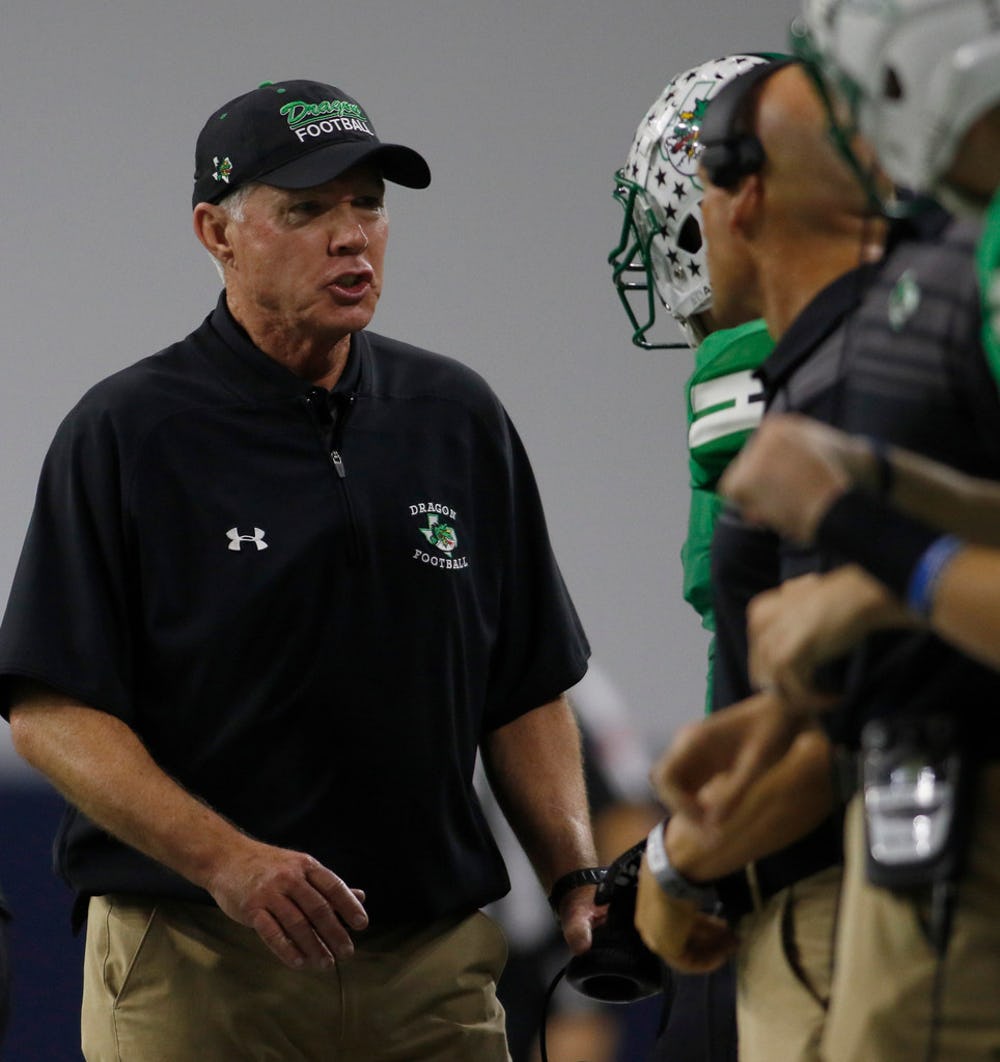
Any day now, word will come down that Hal Wasson, head coach of the Southlake Carroll Dragons, is leaving one of the best high school football jobs in the country.

Officially, Wasson will accept an offer from his employer to buy out the remainder of his contract, and he’ll pack his bags for greener pastures. It’s a fate that awaits most high school football coaches sooner or later. 

But the end for Wasson has been particularly brutal and humiliating, especially for someone who took Southlake Carroll to a state championship in 2011 and rolled up a 121-26 record in 11 seasons as lead protector of the Dragon tradition.

Whether you think he deserves it or not depends largely on where you stand on Wasson, a coach who had the unenviable job of following in the footsteps of the sainted Todd Dodge. Dodge led the Dragons during their legendary – and probably never-to-be-equaled – run of four state championships in five years during the early ’00s and still holds a cherished place in the hearts of all Dragon fans.

How could any mere mortal replace such a towering figure?

Wasson tried, of course, and he wasn’t a complete flop by any means, as his record above proves. But he was no Todd Dodge, in accomplishment or temperament. And that, as much as anything, may be responsible for the messy way in which he departs Dragon Nation.

On Jan. 24, the Carroll school district announced that Wasson had been placed on paid administrative leave while officials investigated his program for possible violations of UIL rules and to determine whether the culture of his program upheld the district’s core values and expectations, the later a nebulous charge that could mean almost anything.

 After four weeks of rumors and speculation – and to the utter delight of Southlake’s many critics – the results of the investigation were released this week and a report sent to the UIL. Meanwhile, Carroll school board members authorized the CISD superintendent to negotiate a contract settlement that would formally end Wasson’s association with the Dragon program.

The list of violations directed at Wasson included holding football camps at times that violated UIL regulations, holding afterschool practices during the offseason, requiring football players to work out on days they had games in other sports and, finally, allowing newly hired coaches to supervise practices before their contracts legally took effect.

I consider that list of particulars pretty thin gruel for the kind of public spectacle the “investigation” produced throughout the DFW area. They’re no better than misdemeanors, the kind of activities you’ll find in many, if not most, high school programs and a far cry from some of the rumored wrong-doing that had tongues wagging furiously among those who follow high school sports. Are they the kind of rule-breaking that should cost a successful, winning coach his job and subject him to the prolonged public shaming that Wasson has endured for the past month? Hardly. If they are, then football coaches all over the state had better dust off their resumes and reconsider their spring and summer practice schedules.

But there is more to this story than that. Of course.

Wasson is a man hard to love from afar. His pre- and after-game interviews, full of platitudes and devoid of substance, were sheer torture, and in 11 years watching him on the sidelines, I never once saw him embrace a player. Perhaps he did and I missed it, but he was not an outwardly emotional guy with his young charges, and that always made me a little suspicious of the man. After all, football is an emotional game, and watching these young athletes give their all on the field for nothing more than a love of the game, hell, I get a little teary just thinking about it.

Wasson was a rigid task-master, by all accounts, heavy on criticism and light on praise. Unlike Dodge, who treated everyone on his squad – from superstar to practice teamer – as valued members of the Dragon family, essential elements of the tradition of success, Wasson was said to favor his starters first, last and always.

Not everyone can be a starter, and the kids who help prepare the varsity for its time under Friday Night Lights play a vital role in the success of big-time high school football, too. Dodge understood that, but Wasson didn’t – at least according to his critics.

Full disclosure: My son is one of those critics. Ethan played freshman football for the Dragons, but then dropped out and took up lacrosse. Much of the reason for that decision was the lingering effects of a concussion he suffered in an 8th-grade game. But Wasson, who he loathed, played a part, too.

“He’s a phony, Dad,” my son confided to me one day. “He shows up for our practice and struts around. Everything he says is BS.”

Ethan claims, and I believe him, that Wasson was widely despised by many of his players. The parents of some of his friends who stayed in the football program confirm this.

When participation rates in Carroll football dropped, some parents pointed the finger of blame at Wasson. Kids didn’t want to play for him, and parents didn’t trust him with their kids. Increasing concerns about concussions no doubt played an important role, too, but the whisper campaign against Wasson steadily grew.

For many Dragon fans, their dislike of Wasson was formed early – during his first season as Dragon coach in 2007. During the third round of the playoffs that year, the reigning state champion Dragons, helmed by Todd Dodge’s son Riley, played Abilene in Texas Stadium.

With Southlake trailing 9-7 late in the first half, Riley Dodge, who had led the Dragons to their 7th state title the year before, dropped back for a pass at the Abilene 10. Just as he released the go-ahead TD throw, he was hit hard and left the game with a separated shoulder.

His backup, Kyle Padron, youngest member of a Carroll football dynasty, performed brilliantly, keeping Southlake in the game despite the loss of the exemplary Dodge.

In the closing minutes of the game, Abilene held a razor-thin 22-21 lead when Padron took the Dragons the length of the field, arriving at the Abilene 10 with 10 seconds left and the clock running. The smart play, the play that every man, woman and child on the Southlake side of Texas Stadium confidently expected, was for Wasson to call Carroll’s final timeout and send out his field goal unit.

Instead, Wasson’s staff ordered Padron to spike the ball, thus stopping the clock and saving the timeout for…what? Padron had never received a snap under center during a game, but he hurried to the line nonetheless. He and the center failed to make a clean exchange, and Padron fumbled the ball. Abilene recovered and ran out the clock. Thus ended the storied Run, a five-year period between 2002 and 2006 when Carroll won four state championships.

In post-game interviews, Wasson blamed the loss on a lack of execution by his offense, rather than the coaching blunder that every Dragon fan – and every player – knew it to be.

It was a despicable thing to do. A dishonorable thing to do. A stupid thing to do. Padron and his teammates had played their hearts out and had come very close to pulling off one of the great comebacks in Dragon history. And Wasson rewarded their courage, skill and determination by kicking them in the teeth.

That was more than 10 years ago, and my face still flushes red at the memory of it.

Over the years, my feelings about Wasson softened somewhat. That’s what winning does. And then there’s the marvelous memory of the 2011 season when Kenny Hill and a wild gray fox had starring roles in a storybook season that ended with the Dragons winning their 8th state title.

At the end of the day, however, I just can’t embrace Wasson. I still can’t get that 2007 post-game interview out of my head, nor can I completely discount my son’s scorn for him as the petty grudge of a pissed-off teenager.

Perhaps he doesn’t deserve the shabby treatment he’s received from Carroll ISD. But in assessing Wasson’s fall from grace, I keep coming back to one thing.

During the past four weeks, not a single one of Wasson’s players, past or present, has stepped forward to publicly defend him, to attest to his character, to his skill as a coach and to his value as a mentor. Not a single one. That fact speaks volumes to me. It is a bitter and awful rebuke.