Saturday, April 28, 2018

A real Texas newsman


For my entire journalism career, Mike Cochran was the newsman I yearned to be.

So when the Fort Worth Chapter of the Society of Professional Journalists chose Cochran as this year’s recipient of its Open Doors Award, the keystone of its annual First Amendment Awards and Scholarship Banquet, I knew I had to be there.

When I entered the banquet hall at Arlington’s Sheraton Hotel, I immediately spotted Cochran, surrounded by old friends and other admirers. I hadn’t seen him in four decades, but he looked no different – well, perhaps a bit grayer and a tad more bent and worn, as befits a man of 81. But his eyes still twinkled and the humor with which he viewed the world was still keen and bright.

Cochran already was a legend when I arrived in the Journalism Department at North Texas State University in the fall of 1971.

By far the J-department’s most famous and accomplished graduate, Cochran had made his name covering the JFK assassination, the UT Tower shooting, the space program and for writing hundreds of other masterly crafted, brilliantly reported stories as the Associated Press’ top reporter in Texas.

He was the epitome of the charming, hard-drinking, charismatic reporter, as comfortable among a group of West Texas oil-field roughnecks as he was among the monied swells at Fort Worth’s Colonial Country Club.

He loved North Texas and maintained close connections with the J-department and chairman C.E. “Pop” Shuford, who he considered a mentor and friend. And because Cochran was mainly based in the AP’s Fort Worth bureau, NT J-students saw him regularly. Simply put, we adored him.

When I was hired by the Lubbock Avalanche Journal right out of college, I saw a lot of Cochran in the A-J newsroom and at newspaper parties around town. Whenever news people gathered to drink and carouse, Cochran was not far away.

I remember one party at a rundown apartment complex tucked away in an obscure Lubbock neighborhood. I had a helluva time finding the place and was a little worried about making my way home after a bellyful of beer.

At one point, a group of us were outside, catching a breath of dry, West Texas air, when around the corner appeared Cochran, his face aglow and his arms full of booze.

“I finally found you bastards,” he puffed as we pounded his back and welcomed him, literally, with open arms.

When I left hours later, he was still holding court, wreathed in smoke and surrounded by laughter, a drink in one hand and the other sweeping the air to illustrate yet another yarn.

I didn’t expect Cochran to remember me when I approached him last night in Arlington. After all, we had been passing acquaintances at best all those years ago.

When he didn’t, he hastened to explain.

“My memory is so bad that I need this badge just to remember my own name,” he said, fingering the paper label on his lapel.

I told him that he had been the paragon during my time at North Texas, and I said I had followed his career closely. “Whenever I came across a Mike Cochran byline,” I said, “I dropped everything and read it. I knew something good was coming, and I was never disappointed.”

Cochran, like many accomplished people I’ve met over the years, is a modest and self-effacing man. He was a little embarrassed by the praise.

“Well, if I was known for anything at the AP, I was famous for my expense accounts,” he said with a grin.

 Cochran retired from the AP in 1999 after a 39-year career in which he covered every major story in Texas, including all three of Fort Worth millionaire Cullen Davis’ murder trials. He wrote books and worked for a few years as a senior writer for the Fort Worth Star Telegram before finally hanging up his spurs in 2004 to enjoy a well-deserved retirement.

Earlier this year, he was inducted into the Texas Newspaper Foundation Hall of Fame. And about damned time, too.

Not surprisingly, the Kennedy assassination is the story that stands out sharpest during his long and illustrious career. Last night, he added a few juicy details to the incident that gained him a footnote in the history books – his role as a pallbearer at assassin Lee Harvey Oswald’s burial.

The funeral home had to ask reporters covering the stark ceremony to bear the casket because no one else wanted any part in toting the despised Oswald to his final resting place.

Famed Star-Telegram writer Jerry Flemmons had turned to his friend and said. “Well, Cochran, if we’re going cover this funeral, it looks like we’re going have to bury the sonuvabitch ourselves.”

Cochran had been reluctant. “I told them no,” he recalled. “Hell, no.”

But when his rival from United Press International offered to take his place, Cochran, an AP man to the core, reconsidered.

“I told them that I had changed my mind, and that I’d do it,” he said. “I may not be the sharpest knife in the drawer, but I’m not stupid.”

In looking back over his career, Cochran recalled how it all began, during his final days at what was then known as North Texas State College.

In the spring of 1958, Cochran was weeks away from graduation when he was offered a job at an Oklahoma oil company making $150 a week, a lofty wage in 1958.

Overjoyed, he rushed to Pop Shuford’s office to deliver the good news.

“Pop, I’ve got a job!” he told his mentor. “I’m going to be a PR man making $150 a week!”

With a knowing smile, Shuford replied, “No, you’re not. I’ve got you a job at the Denton Record Chronicle. You begin next week. You’ll be making $1 a day until you graduate, and then you’ll get $90 a week.”

A flabbergasted Cochran said, “What? Why should I take a job making $90 a week, when I can go to Oklahoma and make $150?”

“Trust me,” Shuford said. “One day you’ll thank me.”

When Shuford died, Cochran asked permission to write a story about his famous teacher. He closed that story in the same way he ended his acceptance speech last night.

Cochran told the SPJ audience his journalism career had reaped benefits beyond his wildest expectations. He had met people, seen things and accomplished things he couldn’t have imagined as he stood crestfallen that day in Pop Shuford’s office. Looking back now, he could think of only one thing to add.
“Thanks, Pop.”

Saturday, March 24, 2018

His father's son


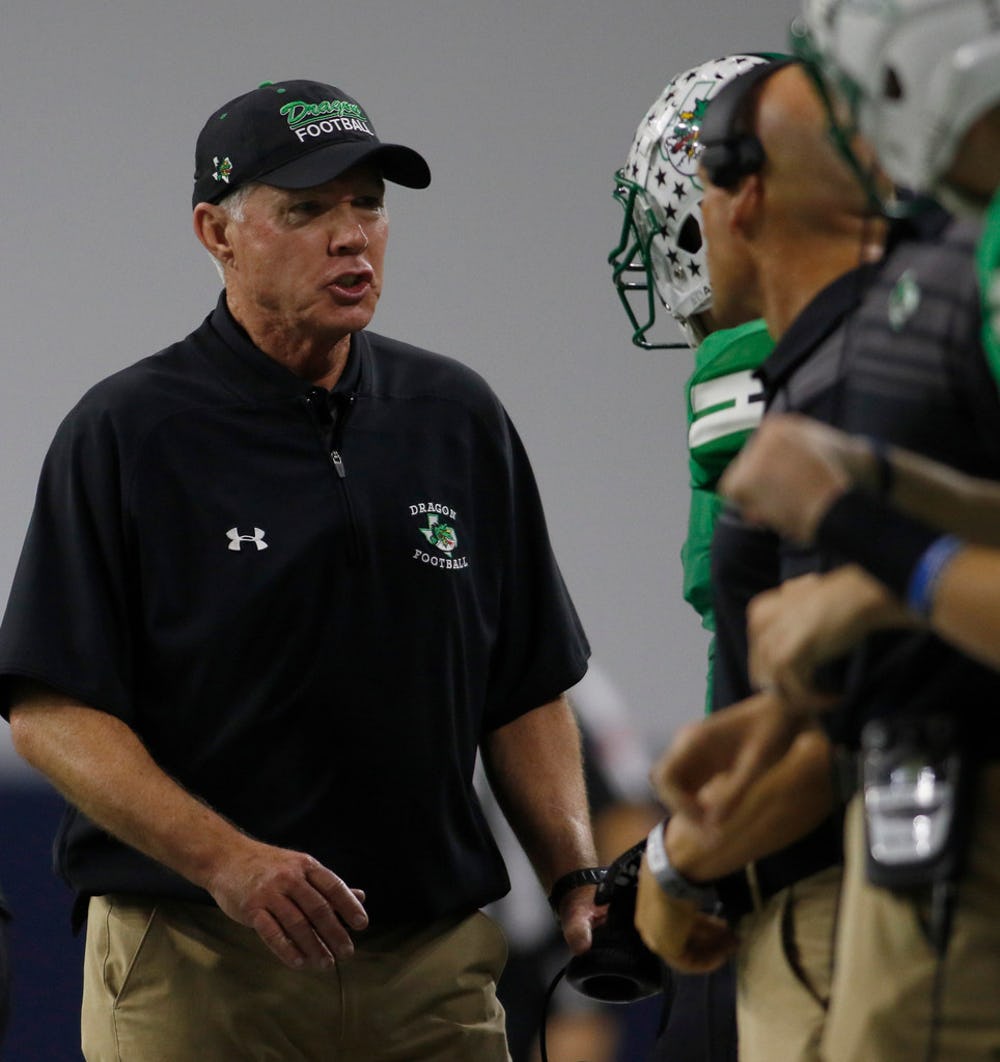
Riley Dodge is returning to the scene of his prime. The former state championship quarterback who learned his craft at the feet of his father, the legendary Todd Dodge, in all likelihood will be named Southlake Carroll’s new head football coach on Monday.

His dad, himself a former state champion quarterback who went on to great success as a UT signal-caller, led Southlake to four state titles in five years, the last one, in 2006, with young Riley helming the offense.

His achievement isn’t likely to be repeated, ever, and Dodge is greatly revered among the Dragon faithful, including, full disclosure, by yours truly.

The elder Dodge, now head coach at Austin Westlake, reportedly was tempted by the chance to return to the place where he gained lasting fame as a football guru and QB mentor. But media reports, if they can be believed, indicate the deal fell through for reasons that aren’t clear.

Denied the services of the king of high school football coaches, Southlake now will settle for the prince, who has never spent a day as a head coach, but who has royal high school football blood coursing through his veins from both sides of his family.

Is Riley up for the job? That’s the question nagging at every Dragon fan’s teeming brain right now. Southlake Carroll, one of the powerhouse football programs in Texas – and by extension in the entire nation – emphatically is NOT a job for a head-coaching newbie.

Carroll has a pampered fan base accustomed to success at the highest levels, and it will demand that the winning continue. It’s been seven years since the last state championship, and Southlake folks are getting a tad antsy. As unreasonable as it sounds, they will fully expect a deep run in the playoffs in Riley Dodge’s inaugural year.

Riley knows what to expect. And if the rumors are true, he will have an important advantage in protecting Carroll’s tradition of winning. It has been reported that Euless Trinity’s famed former head coach, Steve Lineweaver, will be coming to Southlake as a member of the young Dodge’s staff.

 A member of the Texas High School Football Hall of Fame, Lineweaver transformed Trinity into one of the premier football programs in the state and led the Trojans to three state championships before retiring in 2014. Trinity hasn’t been the same since he stepped down, which is as good an indication as any about the importance of getting, and keeping, the right coach.

It’s unclear exactly what job Lineweaver will have on the Dodge staff, but the current storyline is that he will fill a mentoring role for the young coach, giving Riley the benefit of his years of experience and his intimate knowledge of how to motivate young players and guide them to their greatest potential.

Lineweaver shares a common trait with Riley’s father. Players for Todd Dodge and Steve Lineweaver would run through a wall for their coaches. That’s where both men differ from Hal Wasson, the elder Dodge’s successor at Carroll, who left Southlake under a cloud but was just named executive director of athletics at Irving ISD. Many of Wasson’s players, and their parents, loathed him.

Lineweaver knows Southlake Carroll well. The two programs are located only 10 miles apart. They have played several classic games against each other, including their very first meeting – a memorable match before more than 46,000 fans in Texas Stadium during the 2006 playoffs.

That game – between two reigning state champions – was decided when Lineweaver, with his team in the lead, called a fake punt late in the fourth period. The Dragons sniffed out the ruse and took over on downs. The ensuing drive ended with Riley Dodge leaping across the goal line with seconds left, handing Carroll a last-gasp 22-21 victory and expelling Trinity from the playoffs.

Perhaps more significantly, Lineweaver’s son has been an assistant at Carroll for many years, including the period when Riley Dodge wore a Dragon uniform.

I suspect Trinity fans, who enjoy an intense but respectful rivalry with Dragon Nation, are conflicted by the news. Lineweaver is as much an icon in Euless as Todd Dodge is in Southlake. Trojan loyalists love that Lineweaver, who retired in part to escape the pressure and stress of big-time high school football, is back on the sidelines. But they hate, hate that he’ll be in Dragon green and not Trojan black.

Riley Dodge’s other advantage in taking over the Southlake program as a first-time head coach is more intangible. Romantics – and what high school football fan isn’t influenced at least a bit by emotion and imagination – will observe that he’s the scion of two high-achieving football families.

In addition to having the formidable Todd Dodge as his dad, Riley’s maternal grandfather is Ebbie Neptune, athletic director at Austin Westlake for 22 years and head coach from 1982 to 1986. The stadium in which Todd Dodge’s Westlake Chaparrals play is named after him.

For his part, Riley Dodge has packed in valuable experience in spite of his tender years. He’s been an assistant at both Texas A&M and UT, and served as offensive coordinator at both Flower Mound Marcus and, currently, Northwest Justin.

In high school, he was a superstar and a member of three state championship teams. As a sophomore, he was wide receiver for the 2005 state champions, then moved to quarterback as a junior for the 2006 championship season. He was a phenomenal quarterback, fleet-footed with a sure arm. In tight games, and there were several during his time as Dragon quarterback, it was his powerful will to win that carried the team. He was particularly dangerous when flushed out of the pocket, and his broken-field scampers had the crowd on its feet more than once.

He was a natural leader on and off the field. But he also was a generous and loyal teammate, quick to share credit and uncomfortable in the spotlight.

When D Magazine published a controversial story in 2007 about Southlake and its passion for high school football, he was featured in the cover photo for the story, entitled “Why You Should Hate Southlake: Because the Kids are Smarter, Stronger, and Better Looking than Yours, and They Prove It Every Friday Night.”

The story was a fairly accurate and largely benign account of Southlake and its fierce love of Dragon football. But the over-the-top cover and its headline were widely despised and broadly denounced. Riley, it’s said, was particularly chagrined at the cover photo, which showed him radiating arrogance, arms crossed and clad in a gleaming letter jacket, flanked by two other Southlake teen ubermensch.

He said the disdainful expressions on his and his companions’ faces had been coaxed during a lengthy photo session, and none of the kids had any idea the photograph would be paired with such a provocative – and wildly unfair – headline.

In his senior year, the Dragons sailed through the regular season and seemed headed for another state title game when he suffered a separated shoulder against Abilene. The end of his season proved to be the end of the Dragon season, too, and the Run – as the 2002-2006 series of state title games are widely known in Southlake – was over.

Riley, originally committed to UT, instead followed his father to the University of North Texas for the elder Dodge’s ill-fated sojourn in Denton. But Riley’s college career was marred by injury, and he never lived up to the promise of his high school performances. In 2010, he left UNT with two years eligibility and transferred quietly to McNeese State.

As I contemplate the possibilities presented by a new era of what once was known as Dodge Ball, I think back to the 2006 state championship game against Austin Westlake in San Antonio’s Alamodome.

It was my daughter’s freshman year at Carroll, and she performed at halftime with the Carroll Dragon Marching Band. I still have vivid memories of the weekend.

 We stayed in Austin the night before and drove to San Antonio in a downpour. Before leaving Austin, we had breakfast in a crowded restaurant near our hotel. Adorned in Dragon gear, we were a little nervous about our reception, considering our opponent was an Austin team. But the other diners couldn’t have been more gracious, and several wished us luck as we headed out.

The first half was a close-run affair, with the Dragons and the Chaps trading touchdowns. It looked for a while like the game might be won by the last team that scored.

We found out later that Riley Dodge, the linchpin of the Dragon offense, had awakened that day with a severe case of stomach flu. In typical fashion, he had fought through the cramps and other unpleasant symptoms. From the stands, we could detect no letdown by the sturdy Dodge and his fellow Dragons.

The first – and really, only – clue that something was amiss occurred during a Dragon drive at some point in the second half. Riley lined up in the shotgun behind center and crouched slightly, ready to receive the ball. Suddenly, he straightened, turned his head to the right and vomited, an act caught clearly on the televised version of the game but also visible from the stands.

Quickly wiping his mouth, Riley crouched again, barked out the cadence and deftly handled a perfect snap. A second and a half later, he lofted the ball, connecting for a touchdown. The crowd, still bemused by the icky prelude to the pass, exploded in a roar of appreciative joy.

An interesting postscript to the event came a few weeks later when the Dodge family was given a special tour of the White House during a visit to Washington. During the tour, they were granted an audience with President Bush, who had watched the state championship game on TV.

Upon being introduced to Riley, the President grinned and extended his hand. “Hey, you’re the guy who threw up!”

If Riley Dodge can bring to his job as Carroll head coach the same kind of dedication, focused intensity and will to win as he did that rainy day in San Antonio when, fighting chills and stomach-churning nausea, he guided the Dragons to their seventh state title, then Dodge Ball 2.0 will be an unqualified success.

The final score in the Alamodome? Carroll Dragons 43, Westlake Chaparrals 29.

Saturday, March 10, 2018

Hal Wasson’s fall from grace


This entry originally was posted Feb. 24 on Facebook. The next day, Wasson accepted an offer from Carroll ISD to pay the remainder of his contract through the 2019 season. He says he plans to pursue another coaching job.

Any day now, word will come down that Hal Wasson, head coach of the Southlake Carroll Dragons, is leaving one of the best high school football jobs in the country.

Officially, Wasson will accept an offer from his employer to buy out the remainder of his contract, and he’ll pack his bags for greener pastures. It’s a fate that awaits most high school football coaches sooner or later. 

But the end for Wasson has been particularly brutal and humiliating, especially for someone who took Southlake Carroll to a state championship in 2011 and rolled up a 121-26 record in 11 seasons as lead protector of the Dragon tradition.

Whether you think he deserves it or not depends largely on where you stand on Wasson, a coach who had the unenviable job of following in the footsteps of the sainted Todd Dodge. Dodge led the Dragons during their legendary – and probably never-to-be-equaled – run of four state championships in five years during the early ’00s and still holds a cherished place in the hearts of all Dragon fans.

How could any mere mortal replace such a towering figure?

Wasson tried, of course, and he wasn’t a complete flop by any means, as his record above proves. But he was no Todd Dodge, in accomplishment or temperament. And that, as much as anything, may be responsible for the messy way in which he departs Dragon Nation.

On Jan. 24, the Carroll school district announced that Wasson had been placed on paid administrative leave while officials investigated his program for possible violations of UIL rules and to determine whether the culture of his program upheld the district’s core values and expectations, the later a nebulous charge that could mean almost anything.

 After four weeks of rumors and speculation – and to the utter delight of Southlake’s many critics – the results of the investigation were released this week and a report sent to the UIL. Meanwhile, Carroll school board members authorized the CISD superintendent to negotiate a contract settlement that would formally end Wasson’s association with the Dragon program.

The list of violations directed at Wasson included holding football camps at times that violated UIL regulations, holding afterschool practices during the offseason, requiring football players to work out on days they had games in other sports and, finally, allowing newly hired coaches to supervise practices before their contracts legally took effect.

I consider that list of particulars pretty thin gruel for the kind of public spectacle the “investigation” produced throughout the DFW area. They’re no better than misdemeanors, the kind of activities you’ll find in many, if not most, high school programs and a far cry from some of the rumored wrong-doing that had tongues wagging furiously among those who follow high school sports. Are they the kind of rule-breaking that should cost a successful, winning coach his job and subject him to the prolonged public shaming that Wasson has endured for the past month? Hardly. If they are, then football coaches all over the state had better dust off their resumes and reconsider their spring and summer practice schedules.

But there is more to this story than that. Of course.

Wasson is a man hard to love from afar. His pre- and after-game interviews, full of platitudes and devoid of substance, were sheer torture, and in 11 years watching him on the sidelines, I never once saw him embrace a player. Perhaps he did and I missed it, but he was not an outwardly emotional guy with his young charges, and that always made me a little suspicious of the man. After all, football is an emotional game, and watching these young athletes give their all on the field for nothing more than a love of the game, hell, I get a little teary just thinking about it.

Wasson was a rigid task-master, by all accounts, heavy on criticism and light on praise. Unlike Dodge, who treated everyone on his squad – from superstar to practice teamer – as valued members of the Dragon family, essential elements of the tradition of success, Wasson was said to favor his starters first, last and always.

Not everyone can be a starter, and the kids who help prepare the varsity for its time under Friday Night Lights play a vital role in the success of big-time high school football, too. Dodge understood that, but Wasson didn’t – at least according to his critics.

Full disclosure: My son is one of those critics. Ethan played freshman football for the Dragons, but then dropped out and took up lacrosse. Much of the reason for that decision was the lingering effects of a concussion he suffered in an 8th-grade game. But Wasson, who he loathed, played a part, too.

“He’s a phony, Dad,” my son confided to me one day. “He shows up for our practice and struts around. Everything he says is BS.”

Ethan claims, and I believe him, that Wasson was widely despised by many of his players. The parents of some of his friends who stayed in the football program confirm this.

When participation rates in Carroll football dropped, some parents pointed the finger of blame at Wasson. Kids didn’t want to play for him, and parents didn’t trust him with their kids. Increasing concerns about concussions no doubt played an important role, too, but the whisper campaign against Wasson steadily grew.

For many Dragon fans, their dislike of Wasson was formed early – during his first season as Dragon coach in 2007. During the third round of the playoffs that year, the reigning state champion Dragons, helmed by Todd Dodge’s son Riley, played Abilene in Texas Stadium.

With Southlake trailing 9-7 late in the first half, Riley Dodge, who had led the Dragons to their 7th state title the year before, dropped back for a pass at the Abilene 10. Just as he released the go-ahead TD throw, he was hit hard and left the game with a separated shoulder.

His backup, Kyle Padron, youngest member of a Carroll football dynasty, performed brilliantly, keeping Southlake in the game despite the loss of the exemplary Dodge.

In the closing minutes of the game, Abilene held a razor-thin 22-21 lead when Padron took the Dragons the length of the field, arriving at the Abilene 10 with 10 seconds left and the clock running. The smart play, the play that every man, woman and child on the Southlake side of Texas Stadium confidently expected, was for Wasson to call Carroll’s final timeout and send out his field goal unit.

Instead, Wasson’s staff ordered Padron to spike the ball, thus stopping the clock and saving the timeout for…what? Padron had never received a snap under center during a game, but he hurried to the line nonetheless. He and the center failed to make a clean exchange, and Padron fumbled the ball. Abilene recovered and ran out the clock. Thus ended the storied Run, a five-year period between 2002 and 2006 when Carroll won four state championships.

In post-game interviews, Wasson blamed the loss on a lack of execution by his offense, rather than the coaching blunder that every Dragon fan – and every player – knew it to be.

It was a despicable thing to do. A dishonorable thing to do. A stupid thing to do. Padron and his teammates had played their hearts out and had come very close to pulling off one of the great comebacks in Dragon history. And Wasson rewarded their courage, skill and determination by kicking them in the teeth.

That was more than 10 years ago, and my face still flushes red at the memory of it.

Over the years, my feelings about Wasson softened somewhat. That’s what winning does. And then there’s the marvelous memory of the 2011 season when Kenny Hill and a wild gray fox had starring roles in a storybook season that ended with the Dragons winning their 8th state title.

At the end of the day, however, I just can’t embrace Wasson. I still can’t get that 2007 post-game interview out of my head, nor can I completely discount my son’s scorn for him as the petty grudge of a pissed-off teenager.

Perhaps he doesn’t deserve the shabby treatment he’s received from Carroll ISD. But in assessing Wasson’s fall from grace, I keep coming back to one thing.

During the past four weeks, not a single one of Wasson’s players, past or present, has stepped forward to publicly defend him, to attest to his character, to his skill as a coach and to his value as a mentor. Not a single one. That fact speaks volumes to me. It is a bitter and awful rebuke.

Friday, January 26, 2018

Dorothy Estes, educator extraordinaire


Many of my friends and former colleagues are mourning today the passing of Dorothy Estes, a legendary journalism educator at UTA.

Estes was the Student Publications Director at UTA from 1970 to 1996 and oversaw the publication of the Shorthorn, the university’s student newspaper. More than any single person, she is responsible – along with generations of talented student journalists – for the national reputation for excellence the Shorthorn has enjoyed for decades.

But she was more than that. She was a great teacher and a stellar mentor, setting an example for UTA journalists for courage, straight-talk, ethical behavior and dedication to craft that they carried with them when they left campus to join newsrooms across the country.

She was a surrogate mother for thousands of homesick kids facing the first great challenges of their lives away from the nurturing confines of home and hearth. She cared about her young charges, mourning their losses and celebrating their victories, offering a broad and comforting shoulder to cry on or just to rest on for a while.

Estes also was a passionate and eloquent advocate for journalism and its essential role in a free society. She demanded strict and uncompromising adherence to truth, accuracy and precision in the work of her students. But she also understood that students sometimes made mistakes and that they needed space in which to learn from those mistakes and grow as professionals and as people.

I met Estes as a young student journalist at UNT – known then as North Texas State University. She was a friend and colleague of C.E. “Papa” Shuford, the founding chairman of the NTSU J-department, and made regular treks to Denton to consult and commune with him.

At the time, North Texas student journalists were an arrogant bunch, thoroughly convinced we were a part of the top journalism program in the Southwest and one of the best in the nation. We looked down at the world – including the high and mighty UT-Austin – with a blend of unwarranted superiority and vague contempt.

Sigh. We had so much to learn, and the lessons administered by the real world were hard and brutal.

But UTA, smaller in size and stature than it is today, gave us pause. After meeting Estes, we quickly recognized an inspirational leader and a superior educator. I was immediately drawn to her enthusiasm, irreverence and damn-the-torpedoes style.

As for her students, they were quietly competent and sure of themselves. Reading the Shorthorn gave us a shiver of dread and uncertainty. It was good. Damned good. Better than the North Texas Daily? Unthinkable. And yet …

Taking the lead of Estes and Shuford, NT and UTA student journalists formed a bond. We cheered each other’s successes and competed furiously with each other in state and regional contests. When we encountered Estes, she treated us as her own. Once, when I ran into her at a journalism conference in Dallas, she called me by name, and it sent a thrill of exhilaration up my spine. Dorothy Estes knows my name!

Later, when NT and UTA alums met in newsrooms, they became close and trusted colleagues from the start. We shared something that others did not.

The passing of Estes, who died yesterday at age 90, reminds me of the enduring impact of great teachers. If I had to pick the most influential people in my life – the ones who contributed most to making me the person I am today, my parents and my maternal grandmother would top the list. But all the others would be teachers. Erma Stewart and Sharon Ryan at Big Spring High, Dal Herring at Howard Community College, Shuford and Keith Shelton at UNT.

What I learned from those teachers enriched my life and molded me as a human being. My failures can be laid entirely at my feet, but the dedication, wisdom and generosity of those teachers helped pave the way for all my successes. I was lucky to have them. Thank God I had them.

Dorothy Estes was that kind of teacher. And based on the many tributes ringing across social media today, she had that kind of impact on her students’ lives.

Luckily for UTA and its present student journalists, Estes’ legacy of excellence and compassion lives on. My friend Laurie Fox, an Estes student herself, is carrying on in her mentor’s footsteps.

Under Laurie’s supervision, The Shorthorn recently won the American Collegiate Press’ Pacemaker award, the equivalent of a Pulitzer Prize for student publications.

That’s not a bad goodbye present for a renowned journalism educator. Not bad at all.

Monday, January 22, 2018

Journalism and the movies


It has been difficult, after a lifetime of fighting deadlines in newspaper offices across Texas, to sit on the sidelines for the past year and a half and watch the most concerted attack on freedom of the press in the history of the republic.

Trump seeks to destroy the public’s faith in the independent news media in order to consolidate power and to escape accountability for the many sins he has committed in a lifetime of deceit, gluttonous excess and business malfeasance.

It’s still unclear whether he will be successful in his quest. The news media – newspapers and broadcast news networks in particular – have never been weaker and more ill-equipped to counter the assault.

Trump’s efforts to destroy a free press come at a time when the traditional checks and balances on presidential power are being erased – both by a craven dereliction of duty by a subservient legislative branch and by a concerted effort by the Trump regime to stack the judicial branch with far-right zealots.

I believe, because I must, that Trump will fail in his nefarious goal. I believe it when I see the poll numbers, when I see the number of people who marched Saturday in cities across the country.

And I believe it when I see something that happened on Sunday, a small thing really, not terribly significant in the grand scheme of things, but important perhaps as a small promise that the good guys will ultimately carry the day.

I went to see The Post, an excellent film about the Washington Post’s decision to join The New York Times in defying a Nixon administration order not to publish the Pentagon Papers in 1971.

It’s a rousing story of journalistic derring-do – mostly true, for the saga of the Pentagon Papers case is full of intrigue, secrecy and ballsy, in-your-face reporting. Director Steven Spielberg drives home its over-arching message, which couldn’t be more relevant today: A free press serves the governed, not the governors.

As the lights came on in the theater, the credits were greeted by applause from the audience. Applause. In a movie theater in Northeast Tarrant County, one of the most conservative parts of a very conservative state.

To quote Buffalo Springfield, “There’s something happening here. What it is ain’t exactly clear.”

As for the movie, it’s pure joy and immediately makes my list of the best journalism movies ever made, as I expected it would.

Tom Hanks is extraordinary as Ben Bradlee. How an actor as famous as he is can disappear into a character amazes me. I wondered how he would stack up to Jason Robards’ characterization of Bradlee in All the President’s Men. Robards won an Oscar, and Hanks’ work certainly is Oscar-worthy. Wouldn’t it be something if two separate actors won Oscars for portraying the same historical figure?

Meanwhile, Meryl Streep as Katharine Graham is sublime. The moment when she decides to risk everything to publish the papers – against the advice of the gaggle of chattering men advisers who surround her – still gives me goosebumps. She’s that good.

I’m not sure why, but over the years, journalism has served as the inspiration for a number of excellent movies. Perhaps it’s because journalists so often are in conflict with established authority or because their work exposes official malfeasance and human chicanery.

Regardless of the reason, top-flight directors and A-list actors always have been drawn to movies with journalism themes or with journalism backdrops.

My list of favorites appears below. My journo friends no doubt have their own.

There are no wrong answers here. Let the debate begin!

Top 10 Journalism Movies

The Post (2018) – Yes, I know. The New York Times is the real hero of the Pentagon Papers case. Neil Sheehan of the Times got the first copy of the papers and the Times published the first story. The Post was a Johnny-come-lately in the case, albeit an important one. So why is the Post the hero of this movie? Simple. Katharine Graham is a fascinating character. Both newspapers risked a lot by publishing the Pentagon Papers, but hers was perhaps the more difficult decision. Streep’s work here undoubtedly will win her another Academy Award nomination. It’s also Spielberg at his best.

Spotlight (2015)– A brilliantly told story of the Boston Globe’s Pulitzer-winning series about child molestation in the Catholic diocese in Boston. It captures perfectly the culture of the newsroom and the mindset of reporters and editors at a major metro paper in the days before the implosion of the newspaper industry. Spotlight, which won a Best Film Oscar, also portrays better than any movie ever has the methodical, time-consuming and mostly routine process of a major newspaper project. The familiarity of the place and the people brought tears to my eyes at the end.  This movie, along with The Post, illustrates why a free press is essential.

All the President’s Men (1976) – The movie and the 1974 book upon which it is based inspired an entire generation of youngsters to get into journalism. And no wonder. At the time, it was the most realistic portrayal ever of the newspaper industry, and director Alan Pakula and screenwriter William Goldman went to great lengths to insure authenticity, including recreating an exact duplicate of the Post newsroom. The scene of Dustin Hoffman, as Carl Bernstein, trying to convince a source to talk to him brought a shiver of recognition. Taking advantage of her instinctive hospitality, he manages to entice her into providing some information but knows he’ll spook her if he takes out his notebook. So he waits until she leaves the room to get coffee, then pulls out his notebook and scribbles furiously.

His Girl Friday (1940)– Director Howard Hawks had the stellar idea of turning the Hildy Johnson character in this adaptation of The Front Page into a female role. Then he offered the part to many of Hollywood’s top actresses. They all turned it down, but Rosalind Russell jumped at the chance and made the role her own. Cary Grant as crafty, ethically ambiguous editor Walter Burns is a delight, and his scenes with Russell crackle with sexual energy. Known for its rapid, overlapping dialogue, this is by far the best of three screen versions of Ben Hecht and Charles MacArthur’s romp about Chicago-style journalism in the 1920s.

Deadline USA (1952) – Humphrey Bogart is the fighting editor of a New York newspaper about to be sold to a Murdoch-type publisher and put out of business. He decides to go out with a bang by bringing a ruthless mobster to justice. Much of the movie is well-crafted hokum, of course. But there’s a scene in a bar where reporters from the doomed New York Day gather to mourn their paper with cynicism, dark humor and scathing commentary, just as real reporters would do in such bleak circumstances. In the final scene, Bogart is in the press room, watching the pages with the story being bolted onto the press, when he receives a call from the crime boss ordering him to hold the story. Bogart signals the presses to start, then holds the phone to the roaring machines. “You hear that, baby,” he tells the enraged mobster. “That’s the press. The press. And there’s nothing you can do about it. Nothing.”

Broadcast News (1987) – Holly Hunter is wonderful as the brash and brilliant Washington producer of a major network. William Hurt is the dim-witted but telegenic reporter she takes under her wing. And Albert Brooks is the nebbish super-reporter who knows everybody and knows everything but can’t connect with his TV audience or the girl he loves, Hunter. Key scene: Hunter is having an argument with her boss. Says he: “It must be nice to feel like you’re the smartest person in the room – to feel like you’re always right and everybody else is always wrong.” “No,” she quietly replies. “It’s awful.”

The Paper (1994) – I never worked for a tabloid, but this movie made me wish I had – sort of. The New York Sun – a hybrid of the real-life Daily News and Post – is a crazy place, filled with crazy people. An editor obsessed over his chair. A drunken columnist who packs heat for protection. A fistfight between editors in the press room over front-page headlines. A never-ending parade of the bizarre and the unhinged. The place fairly buzzes with an intensity and energy that grabs you by the lapels and carries you along for the ride of your life. Is director Ron Howard’s newsroom fact or fiction? A bit of both, probably. I know the newsroom depicted in the movie was nothing like the one I worked in. At The Dallas Morning News, decorum and order were paramount and shouting matches were rare and usually resulted in disciplinary action. Still, no movie does a better job of capturing the unique dynamic of a big-city newspaper on deadline – the adrenalin-pumping excitement of chasing stories, the exhilarating rush of getting something no one else has. But alas, newsroom “characters” like those in The Paper are a thing of the past. Too bad.


Ace in the Hole (1951) – Billy Wilder wrote, produced and directed this movie about “fake news” almost 70 years before the phrase was invented. Although the movie was one of Wilder’s few commercial flops, it’s a gem. Kirk Douglas is Chuck Tatum, a former big-city reporter fallen on hard times of his own making – drink, women and an unscrupulous approach to work. Exiled to a small newspaper in New Mexico, Tatum encounters what could be his ticket back to the big time. A relics-hunter has become trapped in an abandoned mine, and efforts to remove him are immediately launched. But Tatum understands the story needs time to develop in intensity and drama if he’s to attract the notice of his former metro bosses. So he engineers complications in the rescue efforts. Instead of the necessary hours, it takes days to reach the trapped man, with predictable results. Thank God I never encountered a Chuck Tatum in my long career, but there was this one guy… Umm, no. That’s a story for another time.

Shattered Glass (2003) – Another movie about a disgraced reporter, this time a real one. Stephen Glass achieved a certain level of celebrity by writing edgy, cutting-edge stories in The New Republic until his editors discovered his stories were too good to be true. In fact, the charming Glass had been making things up for years. The scandal almost destroyed the magazine and everyone connected to the fabulist. Initially, the staff rallies around Glass against the allegations, but that support soon evaporates as they begin to understand the depth of his betrayal and the impact of the damage on them. Hayden Christensen, who plays Glass, is extraordinary. His work here makes up, almost, for his excremental portrayal of Anakin Skywalker in the Star Wars saga.

Good Night, and Good Luck (2005) – A movie for our times, if ever there was one. Actor David Strathairn channels journalistic icon Edward Murrow perfectly, right down to the nervous way he takes a drag on his cigarette. George Clooney directed and plays producer Fred Friendly. But he resists the temptation to take a star turn, keeping well in the background and focusing the spotlight on Murrow and other members of his CBS team. Fear is a major character here, the fear that permeated the newsroom in that sad era, when careers were wrecked with heartless abandon by unscrupulous politicians playing to a credulous public. Considering the treacherous landscape, and Joseph McCarthy’s mastery of the process, the decision by Murrow and his team to take on the demagogue is nothing sort of breathtaking.

On the right day, they make the list

Citizen Kane (1941) – Some will be surprised that this movie, which is widely considered one of the best movies ever made, didn’t make my list. Personally, I’ve never been able to warm to it, although it does have a certain majesty about it. Orson Welles was a deeply flawed genius, and if you want to put it on a best-of-all-time list, I won’t argue. Ultimately, however, it’s not a journalism movie at all, but a morality lesson about the corrupting influence of power. OTOH, you can’t deny that at its heart, it’s a crackerjack newspaper tale.

Come Fill the Cup (1951) -- I can’t help but love this movie. When I was a young reporter for the Denton Record-Chronicle, the city editor loaned me the book on which the movie is based. Written by a former Louisiana newspaperman named Harlan Ware, the book is about an alcoholic newspaper man who successfully whips his addiction and resurrects his career. It was the first novel I’d ever read with a newspaperman as a protagonist, and I was completely entranced. Much later, I came across the movie on late-night TV. The opening scene is classic. James Cagney, as the alcoholic reporter, dashes into the newsroom, sits down at a typewriter and quickly bangs out a story about the sole survivor of a plane crash. He hands the story to an editor. The editor reads it and admits it’s the best lead he’s ever read. There’s only one problem. The plane crashed three days ago.

Guilty pleasures

“30” (1959) – With little doubt, this is a stinker. As the best worst movie about journalism ever made, it contains every newspaper cliché in the book. Every one. The script is appalling, and the acting is amateurish, particularly by Jack Webb, who plays the managing editor at his wooden-Indian best. It’s not intentionally funny, but trust me, it’s an immensely entertaining hoot if you’re a journalism junkie, practicing or not. I showed it once at a Society of Professional Journalists soiree in Austin, and it was a smashing success.

The Day the Earth Caught Fire (1955) – This is a British sci-fi treasure. Here’s the set up. A reporter for London’s Daily Express discovers that simultaneous nuclear tests by the U.S. and Russia have thrown the earth out of orbit and sent it hurtling toward the sun. He covers the story as temperatures soar, rivers and lakes dry up, cities empty of people and scientists scurry to find a solution. The movie was filmed with the cooperation of the Daily Express, and many of the scenes were filmed in its Fleet Street building, including the final sequences. When scientists re-enact the nuclear blasts that created the crisis in a desperate bid to reverse the process, reporters gather to await results in a bar across the street from the newspaper office. The camera then travels outside, moving along the deserted streets of an abandoned London. It travels inside the Daily Express building, across the cavernous newsroom, through the empty corridors and finally arrives in the press room. There a pressman waits with mockups of two front pages hanging on either side of him. The camera moves in closer to first one, then the other front page. One screaming headline reads, “EARTH SAVED. Experiment successful.” The other says, “EARTH DOOMED. Experiment fails.” Deadline approaches. Get it?

Friday, December 15, 2017

A new beginning


My son graduates from college tomorrow, a day that marks the official end of child-rearing for Marice and me.

We surrendered front-line parental duties some time ago when our daughter and son stopped needing our constant attention and began regarding us with the sort of benign neglect in which young folks interact with their parents.

For us, the disengagement process began when my daughter left for college in 2010 and now ends when her younger brother walks across the stage at UNT tomorrow morning.

We’ll still be Rachel and Ethan’s parents, of course, but those are formal titles with no real power and few responsibilities, except those assigned by the kids and carefully regulated to keep our interference at a minimum.

Nothing tragic about any of this, understand. It’s a process that’s been repeated millions of times before and will continue, I suppose, until the sun is a cinder in a barren sky.

It seems only yesterday that I wiped a smear of jelly off Ethan’s face before he toddled off to the first day of kindergarten at Johnson Elementary School. The last 16 years have passed in a blur, as they do for every parent.

There are plenty of moments in Ethan’s life I’d like to replay, if only the world worked that way.

n  Infant Ethan struggling unsuccessfully to crawl and thwarted by his chubby little arms and legs.

n   Ethan, in a makeshift robe made of one of my white shirts worn backwards, sitting proudly with other day-school graduates as an auditorium full of parents snap photos.

n  Ethan, face radiant with triumph, holding up his trophy after his flag-football team won the rec league championship.

n  Ethan speeding down the sideline to a touchdown after intercepting a pass during one of his 7th-grade games. Later, the game photographer tells me as I walk in his studio, “Yes, I got it!”

n  Ethan at his bar mitzvah party – dressed in boots, cowboy hat and western shirt – riding the mechanical bull he insisted we rent for the occasion.

n  Ethan, with quiet pride, showing me the team video he was commissioned to make of Carroll High’s boys soccer squad, and my astonishment at how good it really was.

n  Ethan meeting me after a blowout his lacrosse team suffered against Dallas Episcopal and displaying the angry black, blue and green bruises he received playing goalie. “They must have been throwing the ball really hard,” he says laconically. “Bruises usually don’t turn this color for a few days.”

n  Ethan informing me that he was moving out of the Denton apartment he shared with a couple of high school friends because he was bored of “just sitting around and getting stoned all day.” One semester later, he makes the Dean’s List.

And so many more. Life with Ethan has been an interesting ride, and now that I’m coming to the end of an important segment of the journey, I think often of how my son developed from the cheery-faced youngster with a mischievous grin to the solemn, thoughtful young man who drifts in and out of my home today.

When I look at him, I’m reminded of the old saying that “still waters run deep.” He is not who he sometimes appears to be – a feckless 20-something more interested in video games than current affairs, a self-centered, self-satisfied member of his generation.

He is a serious person, this handsome, well-mannered son of mine, a fact reaffirmed this summer as I looked through photographs he and his friends took during a trip to Germany and Switzerland.

Yes, there were the expected number of photos of he and his companions mugging for the camera at tables loaded with steins of good German beer – a great deal of bonhomie recorded for posterity.

But the overwhelming majority of the shots were of examples of magnificent medieval architecture and of exhibits in the many art-filled museums Ethan dragged his friends to. Photo after photo of Ethan standing beside paintings, tapestries and sculptures from institutions across the two countries.

And then there were the photos from Dachau. Ethan’s buddies didn’t want to go to the site of the infamous Nazi death camp. They reasoned it would be too sad, too brutal, too much of a downer, better to find a more pleasant way to spend the afternoon.

But Ethan had just taken a class in the political use of genocide throughout history and so understood the true horror of the place. He insisted on the two-hour train ride.

When I looked at the photos these young men took during the tour – of the appalling barracks (mercifully empty now of the shattered men and women who once inhabited them), the horrific ovens (nightmarish even 72 years after the last hellish ember died), all the stark monuments to unimaginable evil, I felt the sting of tears, which mingled with the pride I felt for my son, who demonstrated the substance of his soul and the depth of his character in taking his friends to that dreadful place.

His plans after graduation are fluid. He’d like to live in Israel for a while, the result of a deeply spiritual Birthright trip he took last summer – and perhaps also because of a girl he met there. There’s always a girl, isn’t there?

I’m against the plan, but of what importance is my opinion in the matter? As I said before, my influence in the direction of my son’s life, never terribly strong, is fading, fading fast.

He still yearns to be a filmmaker, although his ardor is moderated by his understanding of financial realities and the uncertainty of creative success. He loves to travel, to drink good wine, to eat fine food and to live the good life, but he knows such things come with a price tag.

Whatever he does, he’ll make out fine. Whether by design or luck, or both, Marice and I have raised a strong and caring man, a person of substance who understands human nature and human frailties, who recognizes artistic beauty and appreciates artistic creativity. He’s the person I wish I had been at his age, filled with the spirit of adventure and a life of possibilities lying before him.

It will not always be easy, with villains and knaves at every bend in the road ready to derail dreams and detour ambitions. But Ethan, in the words of Faulkner, not only will endure, he will prevail.

Congratulations on your wonderful achievement, my son, love of my life, pride of my life, and may you always enjoy fair winds and following seas.